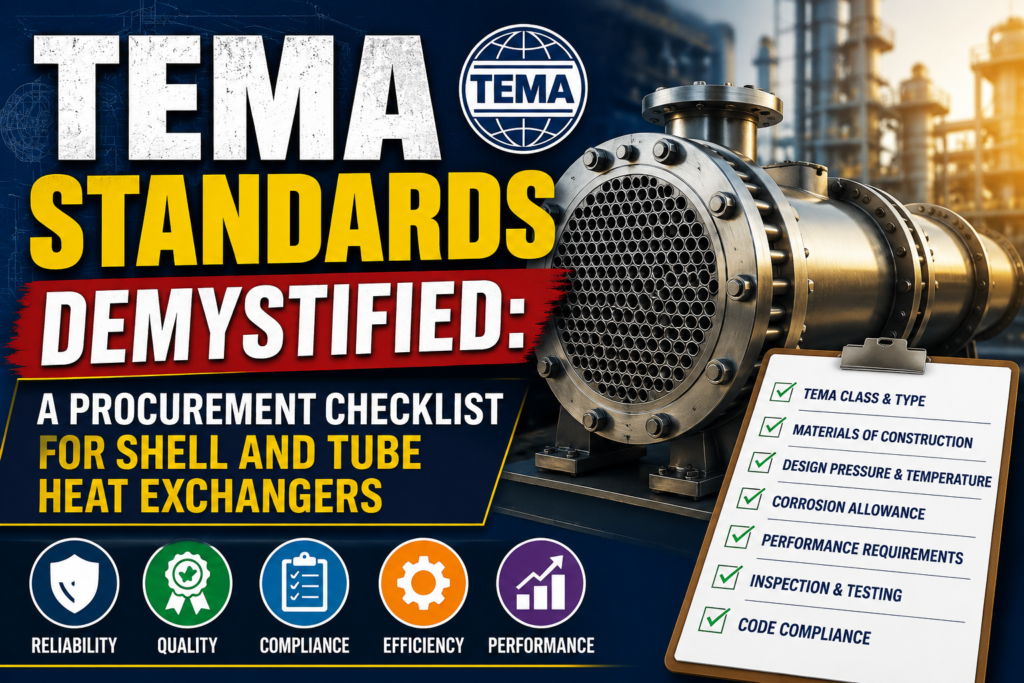
Fixed tubesheet exchangers, where both tubesheets are rigidly welded to the shell, offer the simplest and generally least expensive construction, but they cannot accommodate significant thermal shell and tube heat exchanger suppliers, expansion differential between the shell and the tube bundle without an expansion joint, and the outside of the tube bundle cannot be mechanically cleaned since it is inaccessible without cutting the shell. This makes fixed tubesheet designs best suited to services where both the shell-side and tube-side fluids are relatively clean and thermal differentials are modest.
U-tube exchangers use a single tubesheet with tubes bent into a U-shape,
allowing the tube bundle to expand and contract independently of the shell, which elegantly solves the thermal expansion problem without an expansion joint. The tradeoff is that the inside of the U-bend tubes is difficult to mechanically clean using standard rodding or brushing techniques,
restricting this design to services where the tube-side fluid is relatively clean or where chemical cleaning is acceptable.
Floating head exchangers use two tubesheets,
with one end of the bundle mechanically free to move independently of the shell inside a floating head cover. This configuration handles both significant thermal expansion and allows the entire tube bundle to be pulled for full mechanical cleaning of both the shell-side and tube-side,
making it the preferred configuration for fouling services despite its higher fabrication cost and complexity.
Choosing Metallurgies: Carbon Steel, Stainless Steel, and Copper-Nickel
Material selection for both the shell and tube bundle needs to be driven by the corrosivity and fouling tendency of both process streams,
not just the hot-side fluid that tends to get the most attention during process design. Carbon steel remains the most economical choice for non-corrosive hydrocarbon and utility services,
and is widely used across refinery cooling water and general process heat recovery applications where corrosion allowance can manage through wall thickness rather than exotic alloy selection.
Stainless steel, typically 304 or 316 grade depending on chloride exposure,
becomes necessary where either process stream is corrosive to carbon steel — acidic process fluids,
high-chloride cooling water,
or any pharmaceutical or food-grade application where product purity considerations rule out carbon steel regardless of its corrosion performance. Copper-nickel alloys, particularly 90/10 and 70/30 CuNi,
are the standard specification for seawater and brackish water cooling services,
offering excellent resistance to both general corrosion and biofouling in marine environments,
and remain the default choice for coastal refinery and power plant cooling applications despite their significant cost premium over carbon steel shell and tube heat exchanger suppliers.
Key Thermal and Mechanical Data Points to Validate Before Fabrication
Before releasing a purchase order, procurement teams should insist on reviewing — not just receiving after the fact — the thermal design calculation package,
including the log mean temperature difference (LMTD) correction factor, overall heat transfer coefficient assumptions,
and fouling factor allowances applied for both streams. Fouling factors in particular are frequently a point where suppliers apply overly optimistic industry-standard values that don’t reflect the actual fouling tendency of the specific process stream,
resulting in an exchanger that underperforms once fouling accumulates in real operating conditions.
Mechanical data points worth validating independently include the design pressure and temperature margins against actual process conditions,
the tube-to-tubesheet joint method (expanded, welded, or both),
and the specified corrosion allowance on both shell and tube materials. For any exchanger operating above roughly 15 bar or handling hazardous process fluids,
requiring independent third-party design review alongside the fabricator’s own calculations is a reasonable and increasingly standard procurement practice.
Sourcing Verified Heat Exchanger Fabricators Across India
India’s fabrication sector includes a wide range of capability levels,
from small workshops capable of straightforward carbon steel units to fully coded fabricators certified for ASME Section VIII pressure vessel construction and equipped for exotic alloy welding. For procurement managers vetting coded process equipment suppliers,
requesting the fabricator’s current ASME “U” stamp certification,
along with recent project references in comparable service conditions,
provides a meaningfully more reliable signal than general company size or years in business alone.
Tube Bundle Vibration: An Often-Overlooked Failure Mode
Beyond thermal and corrosion considerations,
high-velocity shell-side flow can induce tube vibration severe enough to cause fatigue failure at tube supports or tube-to-tubesheet joints over time,
a failure mode that is frequently underappreciated during initial procurement discussions focused primarily on thermal performance. Flow-induced vibration analysis,
evaluating the shell-side flow velocity against the tube bundle’s natural frequency and support spacing,
should be a standard part of the mechanical design package for any exchanger operating at higher shell-side velocities,
particularly for gas or low-viscosity liquid services where vibration risk is greatest.
Tube support plate spacing is the primary design variable used to manage this risk,
with closer spacing increasing the tube bundle’s natural frequency and reducing vibration amplitude,
at the cost of increased shell-side pressure drop and fabrication complexity. Procurement managers evaluating a fabricator’s design package should specifically ask whether flow-induced vibration analysis was performed,
particularly for any exchanger operating outside of well-established, previously proven service conditions,
since this is a detail that is easy to omit from a standard thermal design calculation but can be the actual root cause of an in-service failure years after commissioning.
Frequently Asked Questions
What is the difference between TEMA and ASME code applicability for heat exchangers? ASME Section VIII governs the pressure-retaining mechanical design of the shell and heads,
while TEMA provides supplementary mechanical design standards, tolerances,
and nomenclature specific to shell and tube construction; most shell and tube exchangers are built to satisfy both frameworks simultaneously rather than one in place of the other.
How often should a shell and tube heat exchanger’s tube bundle be cleaned? Cleaning frequency depends entirely on the fouling tendency of the process streams involved,
and should be determined based on actual performance monitoring — tracking the exchanger’s heat transfer performance against its clean design baseline — rather than a fixed calendar schedule that may not reflect actual fouling conditions.
Can a fixed tubesheet exchanger be converted to a floating head design later? Generally no — the mechanical configuration is a fundamental design decision embedded in the shell and tubesheet construction, and converting between configurations after fabrication is not practically feasible,
which is why selecting the correct configuration at the specification stage is so important shell and tube heat exchanger suppliers.
What documentation should accompany a completed heat exchanger? A complete documentation package should include mill certificates for shell and tube materials,
the thermal design calculation summary, hydrostatic test certificates for both shell-side and tube-side, NDT reports,
and a general arrangement drawing reflecting the as-built configuration.
Buyers can compare fabrication capability and specification ranges among shell and tube heat exchangers for industrial process heating listed through Vessel India to build an initial shortlist before issuing detailed technical RFQs.