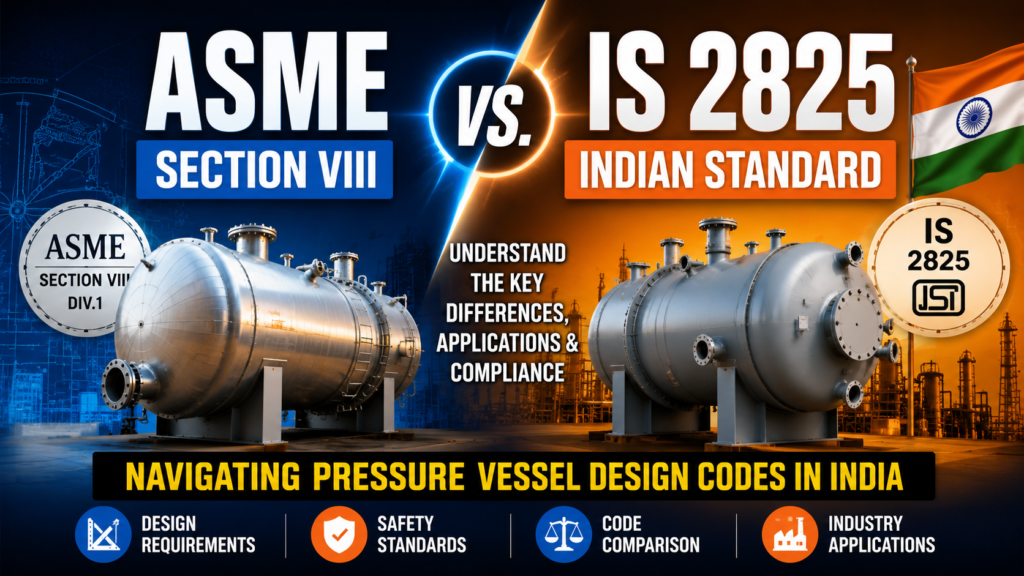
Choosing which design code a pressure vessel should be built to is one of the earliest and most consequential decisions in any industrial equipment procurement process — and it is a decision that gets significantly more complicated in India, where multiple overlapping regulatory frameworks apply depending on the vessel’s service, location, and end customer. This article walks compliance engineers and global procurement directors through the practical differences between the two dominant standards governing ASME certified pressure vessels in India.
The Regulatory Landscape of Pressure Vessel Engineering in India
India’s pressure vessel regulatory environment operates on two broad tracks that frequently intersect. The domestic regulatory framework is anchored by the Indian Boiler Regulations (IBR) for steam-generating and steam-handling equipment, and by IS 2825,
the Indian Standard for unfired pressure vessels, which covers a much broader range of general pressure vessel applications. Running alongside this domestic framework is the American Society of Mechanical Engineers’ Boiler and Pressure Vessel Code, Section VIII,
which is not a legal requirement within India but is very frequently specified by multinational customers, export contracts,
and projects financed by international lenders who require ASME compliance as a contractual condition.
For a global procurement director sourcing equipment for a facility in India but ultimately answerable to an international quality standard,
or for an Indian EPC contractor exporting fabricated equipment,
understanding which code — or which combination of codes — actually applies to a given project is a foundational first step that should be settled before requesting quotations,
since it materially affects both fabricator capability requirements and cost.
ASME Section VIII (Div 1 & 2) vs. IS 2825: Safety Factors and Design Margins
The most consequential technical difference between the two codes lies in their design safety factors. ASME Section VIII Division 1 traditionally applies a safety factor of 3.5 on the material’s ultimate tensile strength,
though this was tightened in more recent code editions. IS 2825 applies a broadly comparable but not identical safety margin framework,
and the two codes’ allowable stress tables for the same nominal material grade can produce meaningfully different calculated wall thicknesses for an identical design pressure and diameter.
ASME Section VIII Division 2, sometimes called the “alternative rules” division, permits a lower safety factor in exchange for significantly more rigorous design analysis, material testing,
and non-destructive examination requirements — effectively trading a more expensive and time-consuming design and fabrication process for a lighter,
more material-efficient vessel. Division 2 is generally reserved for very high-pressure applications or projects where the material savings justify the additional engineering and inspection cost,
and it is not the default choice for most standard industrial pressure vessel procurement.
Procurement directors should treat “ASME certified” as a starting point for a conversation rather than a complete specification, and confirm explicitly which division,
and which specific code edition and addenda,
a quote vessel is design to, since code requirements do change between editions and a vessel design to an outdated edition may not satisfy a current customer or regulatory requirement.
When is Indian Boiler Regulations (IBR) Certification Mandatory?
IBR certification is a distinct and legally mandatory requirement in India, separate from voluntary ASME specification,
and it applies specifically to steam boilers and associated steam-pressure equipment operating above defined pressure and temperature thresholds. Any vessel that generates, stores,
or handles steam under pressure within India — regardless of whether it is also built to ASME or IS 2825 mechanical design rules — typically requires IBR approval from the relevant state Boiler Inspectorate before it can legally commission and operate.
This creates a scenario procurement teams frequently encounter: a vessel designed and fabricated to ASME Section VIII for a multinational customer’s global standard may still require separate IBR certification and inspection sign-off if it will operate within Indian territory and involves steam service. Confirming this dual-compliance requirement early in the procurement process — and specifying a fabricator experienced in navigating both frameworks simultaneously — avoids the costly delays that arise when this requirement surfaces only at the commissioning stage.
Sourcing High-Pressure Systems for Lethal or High-Vacuum Process Loads
Vessels handling what ASME classifies as “lethal service” — fluids that are lethal even in small concentrations when inhaled — trigger additional mandatory requirements under Section VIII,
including full radiographic examination of all pressure-retaining welds rather than the spot radiography permitted for standard service,
along with more stringent post-weld heat treatment and impact testing requirements depending on the operating temperature range. High-pressure reactor manufacturing for such services demands fabricators with demonstrated experience in these elevated requirements,
not simply general ASME certification.
Full vacuum service presents its own distinct engineering challenge, since external pressure design calculations govern rather than the more commonly referenced internal pressure calculations,
and vessels that are perfectly adequate for internal pressure service can buckle catastrophically under vacuum if the external pressure case was not independently verified during design. Any procurement specification involving vacuum operation should explicitly call out the external pressure design case as a required deliverable in the fabricator’s design package.
Vetting Vendor Welding Procedure and Welder Qualifications
Regardless of which code governs the vessel, the integrity of the final product depends heavily on the documented competence of the people and procedures doing the welding. Welding Procedure Specifications (WPS) document the exact parameters — material grades,
filler metal, preheat, interpass temperature,
and post-weld heat treatment — that a fabricator commits to following for a given joint type,
while Procedure Qualification Records (PQR) provide the destructive test evidence proving that a WPS actually produces a sound weld meeting code requirements. Welder Performance Qualifications (WPQ) then certify that the individual welder executing the work has demonstrated competence with that specific qualified procedure.
Compliance engineers should request and review current WPS, PQR,
and WPQ documentation for the specific joint types and material grades involve in their vessel — not generic company-level welding certification — before a fabricator is approve to begin work,
since welder qualifications can and do lapse, and a company’s general reputation does not substitute for current, joint-specific qualification evidence.
Documentation Package Expectations for Coded Vessels
A vessel’s compliance with any pressure vessel code is only as credible as the documentation that supports it,
and global procurement directors sourcing from Indian fabricators should establish clear expectations for the complete documentation package at the contract stage. This typically includes the code data report (such as ASME’s Manufacturer’s Data Report, Form U-1),
mill test certificates for all pressure-retaining materials with heat number traceability, the complete NDT report package,
hydrostatic or pneumatic test certificates, and, where applicable,
the IBR approval certificate for steam service.
For projects involving export shipment, additional documentation such as certificates of origin,
packing lists formatted to the destination country’s customs requirements,
and any third-party inspection release certificates should also scop and agreed in advance,
since assembling these documents after the vessel is already fabricate and ready for shipment frequently becomes the critical path item delaying final delivery,
even when fabrication itself was completed on schedule. Building a documentation checklist into the original purchase order, with clear responsibility and timeline for each document,
is a simple but consistently underused practice that prevents this last-mile delay.
Frequently Asked Questions
Is ASME certification legally require for pressure vessels operating in India? No — ASME Section VIII is not a legal requirement within India,
but it is very frequently specified contractually by multinational customers, export markets,
or international project financing conditions,
making it a de facto market requirement even though the legally mandatory domestic frameworks are IS 2825 and, where applicable, IBR.
Can a vessel dual-certifie to both ASME and IS 2825? Yes, and this is common practice for fabricators serving both export and domestic Indian markets,
though it requires the design calculation to satisfy the more conservative requirement of the two codes at every point where their allowable stress or safety margin values differ.
How long does IBR certification typically take? IBR approval timelines vary by state Boiler Inspectorate and current application volume,
but procurement teams should generally budget several weeks for design approval and additional time for final inspection and commissioning sign-off,
and should build this into the overall project schedule rather than treating it as a formality handled at the end.
What happens if a fabricator’s ASME code edition is outdate? A vessel designed to a supersede code edition may not satisfy a customer’s current contractual requirement or may face challenges during international export documentation review,
so confirming current edition and addenda compliance in writing before order placement is an important procurement safeguard.
Procurement directors sourcing coded equipment can review a range of ASME-certified pressure vessels available through Vessel India to compare fabricator certifications and code compliance documentation before shortlisting for a formal technical bid.