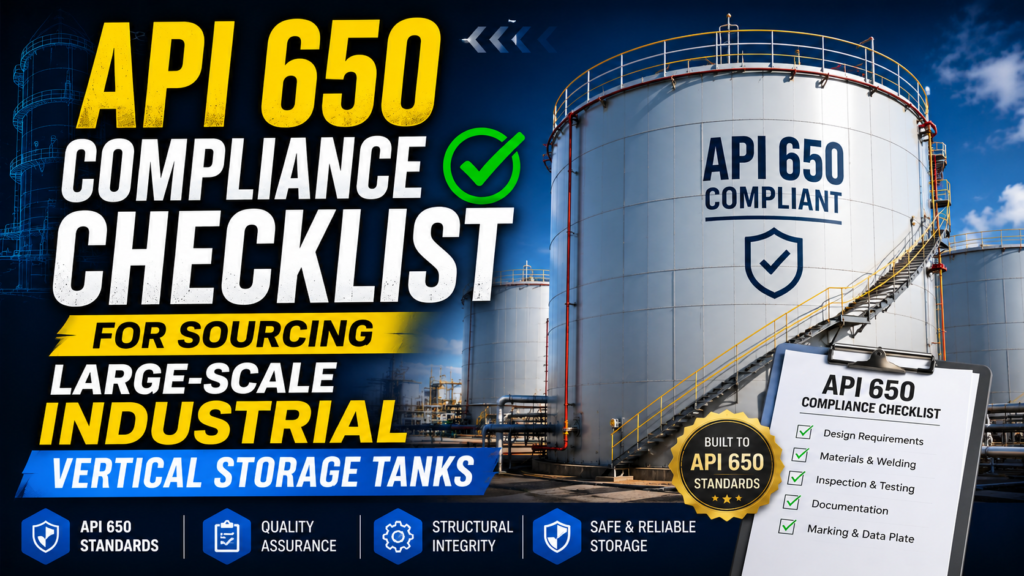
Large atmospheric storage tanks rarely fail dramatically or without warning — they fail slowly, through foundation settlement, corrosion, or a design margin that was never quite adequate for the site’s actual wind or seismic loading, and by the time the problem becomes visible it is usually an expensive one to fix. For facility managers responsible for petroleum, fertilizer, or bulk chemical storage, understanding the compliance framework behind industrial storage tanks under API 650 — and knowing which parts of that framework are frequently under-specified by cost-driven fabricators — is essential due diligence before any large tank procurement.
Atmospheric Storage Safety: Why API 650 Formulates the Baseline
API 650, published by the American Petroleum Institute, is the globally recognized design and construction standard for welded steel atmospheric storage tanks,
and it has become the de facto baseline specification for large-scale vertical storage tanks across the oil and gas, petrochemical,
and bulk chemical storage industries worldwide,
including extensively in India despite it being a US-originated standard. The code covers everything from plate material selection and minimum thickness calculations through to shell design, roof configuration,
foundation interface requirements, and testing procedures.
What makes API 650 particularly relevant for facility managers rather than purely a design engineer’s concern is that the standard directly addresses site-specific loading conditions — wind speed, seismic zone,
and roof live load — that vary significantly by geographic location,
meaning a tank design that is perfectly adequate for one site can be genuinely under-designed if simply replicated for a site with different environmental loading without re-running the applicable calculations.
Structural Differences: Vertical, Horizontal, and Underground Tank Design
While API 650 specifically governs vertical, cylindrical,
welded steel tanks with a flat or low-slope roof, procurement teams evaluating overall storage strategy should understand where this design fits relative to horizontal and underground alternatives. Vertical tanks offer the most cost-efficient storage volume per unit of land area at large capacities,
and their construction — built up in courses from the bottom shell ring upward — scales efficiently to very large diameters and heights,
making them the standard choice for bulk terminal and refinery tank farms.
Horizontal tanks, generally fabricated to a different pressure vessel code depending on their design pressure, are typically reserved for smaller-volume storage applications or situations where a low profile is required for site layout or aesthetic reasons,
and they lose cost efficiency rapidly as required storage volume increases. Underground storage introduces an entirely different set of structural considerations around external pressure design,
corrosion protection (typically requiring cathodic protection systems),
and leak detection monitoring, and is generally reserved for applications with specific regulatory or site constraints driving that choice rather than being a default preference.
Carbon Steel Selection: Utilizing SA 537 Class 2 and SA 516 Grade 70 Plates
Plate material selection has a direct and significant impact on both tank cost and long-term performance,
and API 650 permits a range of carbon steel grades depending on the design temperature, plate thickness,
and required impact toughness at the site’s minimum design metal temperature. SA 516 Grade 70 is among the most widely specified plate grades for general atmospheric storage tank construction,
offering a good balance of strength, weldability, and cost for standard ambient-temperature service.
For tanks requiring higher toughness — typically driven by low minimum design metal temperatures in colder climates,
or by thicker plate sections in the lower shell courses of very tall tanks — SA 537 Class 2,
a quenched and tempered plate grade,
offers substantially improved impact toughness and allows for higher allowable stress values,
which can translate into reduced plate thickness and material cost even though the per-tonne price of the plate itself is higher. Facility managers should ensure their fabricator’s material proposal is driven by the actual site design temperature and stress calculation rather than defaulting to whichever grade the fabricator happens to have readily available in inventory.
Wind Girder and Seismic Calculations for Large-Scale Outdoor Facilities
Open-top and floating-roof tanks require a wind girder — a stiffening ring near the top of the shell — to prevent the thin upper shell courses from buckling under wind-induced suction loads,
and API 650 provides specific calculation methods for determining the minimum required wind girder section modulus based on the tank’s diameter, height,
and the site’s design wind speed. Under-designed wind girders are a recurring finding in tank inspection audits,
often traceable to a fabricator using a generic regional wind speed assumption rather than the actual site-specific value required by the local building code.
Seismic design, where applicable, introduces additional considerations including overturning moment calculations, anchor bolt sizing (or verification that an unanchored tank design is appropriate for the site),
and sloshing wave height calculations that affect required freeboard between the liquid surface and the roof. For facilities in seismically active regions,
requiring an independent seismic calculation review — separate from the fabricator’s own design package — is an increasingly standard risk mitigation practice for major storage projects,
given the potentially severe consequences of a seismic-related tank failure at a bulk storage facility.
Foundation Sizing and Tank Site Erection Strategies in India
A tank’s structural integrity depends as much on its foundation as on the shell and roof design itself,
and foundation design needs to account for the tank’s full operating weight, soil bearing capacity at the specific site,
and differential settlement tolerances that the shell and bottom plate design can safely accommodate. Ring-wall foundations,
which support the tank shell on a reinforced concrete ring while the tank bottom rests on a compacted granular fill pad, are the most common approach for larger tanks,
offering better settlement control than a simple slab foundation across the full tank footprint.
Erection strategy for large tanks in India typically follows either conventional bottom-up construction,
building each shell course sequentially from ground level,
or jacking methods where the roof and upper shell courses are constructed first at ground level and progressively jacked upward as lower courses are added beneath — a method that can significantly reduce elevated work and improve safety outcomes on very tall tanks,
though it requires a fabricator with specific jacking-method experience and equipment.
Corrosion Protection and Long-Term Maintenance Planning
A large storage tank represents a multi-decade capital investment,
and corrosion protection strategy determines whether that full service life is actually achieved or whether the tank requires premature and costly bottom or shell replacement well before its design life is reached. Internal coating systems,
selected based on the specific product stored, protect the tank bottom and lower shell from the corrosive effects of any water phase that settles beneath the stored product,
a common condition in crude oil and many chemical storage applications where trace water is essentially unavoidable over time.
Cathodic protection, typically implemented through either sacrificial anodes or an impressed current system, provides additional protection to the tank bottom’s external surface where it contacts the foundation pad,
addressing a corrosion mechanism that internal coating alone cannot reach. External shell coating, meanwhile,
protects against atmospheric corrosion and should specifie with a maintenance recoating interval built into the facility’s long-term asset management plan from the day the tank is commission,
rather than being address reactively once visible coating failure appears.
Facility managers should also plan for periodic out-of-service inspection,
including bottom plate ultrasonic thickness surveys,
on a schedule aligned with applicable regulatory requirements and the tank’s actual service severity,
since these inspections are the primary mechanism for catching gradual corrosion-related thickness loss before it progresses to a point requiring emergency repair or unplanned tank outage.
Frequently Asked Questions
How long does API 650 tank construction typically take from order to completion? Timelines vary significantly with tank diameter and site erection method,
but large-diameter tanks commonly require several months from foundation completion through final shell erection, roof installation, and hydrostatic testing,
and this should plan as a distinct project phase with its own realistic schedule rather than compress into a generic equipment delivery estimate.
Does API 650 cover tank roof design, or only the shell? API 650 covers the complete tank including shell, bottom, and roof design — both fixed cone or dome roofs and floating roof configurations — along with the wind girder, nozzle, and appurtenance requirements needed for a complete, code-compliant tank.
What inspection is require before a new storage tank enters service? New tanks require hydrostatic testing (or an approved alternative method for very large tanks where full water fill is impractical) to verify shell and bottom integrity,
along with a complete visual and dimensional inspection confirming as-built conformance to the approved design drawings before being release for product service.
Can an existing storage tank re-rated for a different product or higher capacity? Re-rating is possible in some cases but requires a full engineering evaluation of the existing shell, bottom,
and foundation against the new service conditions, and may require additional NDT of the existing structure to confirm remaining wall thickness and corrosion condition before approval.
Facility managers can review capability and project references among established crude oil storage tanks and process equipment fabricators through Vessel India to evaluate potential partners for large-scale tank procurement projects.